• Home Page
  • About this website
  • Biography
  • Dr. B's Notes
  • Contact
Richard S. Beam

341 Schools are starting up again!

8/5/2026

0 Comments

 
My calendar says that the Millard School District of Omaha (our local one) is going to start its classes next week, so I guess that it’s THAT time of year again.  I spent quite a few years attending school as a student and a good many more on the other side of the desk.  All things considered, they were (as I nostalgically look back on them) not bad years.  I think I even enjoyed them.  That may well be because my father had a PhD in Electrical Engineering and was a member of the EE faculty at Northwestern University from before I was born until he retired; my mother (the daughter of an English Professor/ A&S Dean) had a Master’s degree in Library Science, worked in a couple of university libraries prior to her marriage and, after her children were grown, was “certified” as a “School Librarian,” and worked in that capacity for the Evanston Public School system for a number of years.  My brother, had a PhD in Political Science, spent a number of years as the Director of the Graduate Program in Public Administration at Illinois Institute of Technology, and was married to a high school teacher.  Even my sister married a (now retired) high school History teacher and Dean of Students. 

Obviously, things educational played a significant role in much of my early life, so it doesn’t seem unlikely that I would have decided to work in the field of education.   So, after determining that I loved many aspects of the Theatre, I discovered, that I got too much pleasure (and could earn a somewhat modest, but adequate, living) working in Theatre Education trying to pass along what I knew (and continued to learn) to others in the classroom, the shop, and in production AND I decided that I really did NOT wish to devote my life to the trials of working in “professional” theatre.  I believed (still do) that being in Theatre Education was a worthwhile way to devote my time and energies.

Given the above, what else could I do but what I did?  I believe that something of a passion for teaching still runs in my blood, so I think it’s appropriate to do a post related to the beginning of the school year.  So, here goes!

One of the first challenges to starting the school year, of course (even for teachers, who have “Faculty Meetings” to attend prior to classes actually beginning) is just forcing one’s self to get up and get started after (sometimes) having a more relaxed and flexible schedule when school is not in session.  Hence, this cartoon makes a good deal of sense to lead off any discussion of starting the school year.
Picture
All teachers, I suspect, both look forward both to STARTING the year and to GETTING that chore over, and it MAY be worse when your class load and schedule changes rather completely every Quarter or Semester!  On the other hand, some teachers (perhaps especially at the university level), have, or may HAVE had, fantasies about how to “break the ice” with their students on that first day, leading to some fantasies about unusual behavioral choices.  Below, I reprint some extracts from “50 Fun Things for Professors to Do on the First Day of Class” by Alan Meiss as examples.  (HIs full list DOES number 50 items, but these struck me as the most generically useful.)

1.    Pick out random students, ask them questions, and time their responses with a stopwatch. Record their times in your grade book while muttering "tsk, tsk”.

2.     Play "Kumbaya" on the banjo.

3.     Announce "you'll need this", and write the suicide prevention hotline number on the board.

4.     Announce to students that their entire grades will be based on a single-question oral final exam. Imply that this could happen at any moment.

5.     Every so often, freeze in mid sentence and stare off into space for several minutes. After a long, awkward silence, resume your sentence and proceed normally.

6.     Announce that last year's students have almost finished their class projects.

7.     Sprint from the room in a panic if you hear sirens outside.

8.      Give an opening monologue. Take two minute "commercial breaks" every ten minutes.

9.      Ask students to list their favorite show tunes on a signup sheet. Criticize their choices and make notes in your grade book.

10.   Sneeze on students in the front row and wipe your nose on your tie.

Mind you, I have never actually tried any of these techniques out, and I’m not sure I would recommend doing so, but they COULD lead to some interesting results.  On the other hand, perhaps some more useful tips would include the idea of following Aunty Acid’s advice, especially with rambunctious younger kids.
Picture
A (perhaps?) useful notion with students who are a bit older (upper grades and high school?) would be to just post a sign (something like the one below) where all of the students can EASILY see it, but to NEVER actually mention it, or point it out.  One MIGHT, however, if it became necessary, just stop and, VERY quietly, take a LONG, OBVIOUS look at it.  I have a suspicion that this technique MIGHT be more effective than one might initially believe at first thought!
Picture
One must, however, especially with the youngest kids, never underestimate them.  Most of the time they are much more aware of what’s actually going on in the school than adults might think.  I think this idea is captured quite well in this cartoon from For Better or For Worse, where a Dad is tucking his kindergarten daughter in bed after her first week in school.
Picture
On the other hand, teachers, especially Professors, need to be careful when talking to students about the work for their class.  They should be sure to reinforce the idea that they expect their students to be engaged in serious WORK, especially when that work involves the sciences.  Otherwise the students might actually come to understand the truth of the message of THIS picture.
Picture
I confess that that image brings up what is a rather sore point for me.  Far too often, especially at the University level, the “Trinity” of Teaching, Service and Research is touted as being the proper function of “Professorship.”  What I saw, much too often in my opinion, was that “Teaching” was assumed to be acceptable (or better) pretty much as long as one wasn’t sued or charged with illegal behavior; “Service“ was, almost exclusively, valued only when it promoted one’s university within the greater profession OFF CAMPUS, and “Research” wasn’t worth much unless it was published in “scholarly” journals and/or presented at professional conventions (even if such “publications and presentations” were only to small (sometimes VERY small) gatherings of highly specialized “scholars” in, highly “specialized” fields.  And, of course, getting a textbook published was like winning an Emmy, an Oscar, a Tony, or a Pulitzer Prize, especially if it was “adopted” by others.  
​

I think this Non Sequitur (below), supports this notion quite clearly and, while it IS specifically focused on drug-related research for commercial purposes, I would suggest that the basic idea also applies to the vast majority of fields of study.
Picture
After all, the REAL point of research is to promote one’s university as being at the “top of the field”  in order to obtain grant monies, which will allow it to attract the best GRADUATE students, who will actually DO most of the actual research work (under faculty “supervision.”  BUT, such work will reflect well on the UNIVERSITY as a whole, and, of course, on the “Supervising Professor.”  But enough grinding of THAT axe.  

One thing I believe that teachers at all levels (except, perhaps, those who teach the very young) notice, is that, eventually, the STUDENTS start to seem to be getting younger, while they (the faculty) don’t feel like they have gotten all that much older.  (DO THEY?  DID I?)  I don’t remember being conscious of this impression until relatively late in my teaching career, but this Zits cartoon suggests that it might even happen to “upperclass” students, as well, though I don’t remember that from my own “student” experience.
Picture
However, as much as the vast majority of students quickly decide that they “can’t wait for next summer to come,”  I would suggest that much the same is true of teachers as is suggested by THIS (below) from Six Chix.
Picture
I think that a really smart Elementary School Principal might increase morale among his/her faculty by installing something of this sort in her/his school’s “Teacher’s Lounge.”  I strongly suspect that it would at least get a few laughs, and might well relieve some of the pressure during the middle of the school year.  At least, it wouldn’t have to cost a lot and would be a fun thing for the faculty and staff.

I’ll be back in a couple of weeks.  I hope, especially if you’re about to start school, you have a good year, and remember, it WILL, eventually, be over.  At least until you have to do it all over again next year….

🖖🏼 LLAP,
Dr. B

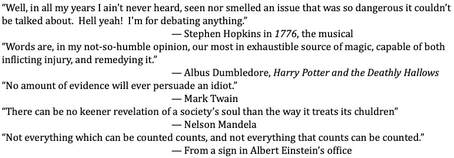
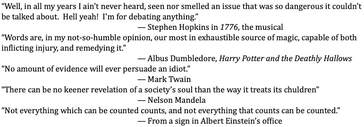
"Well, in all my years I ain't never heard, seen nor smelled an issue that 
was so dangerous it couldn't be talked about. Hell yeah! I'm for 
debating anything."
                - Stephen Hopkins in 1776, the musical
"Words are, in my not-so-humble opinion, our most in exhaustible 
source of magic, capable of both inflicting injury, and remedying it.'
                - Albus Dumbledore

"No amount of evidence will ever persuade an idiot."
                - Mark Twain

"There can be no keener revelation of a society's soul than the way it 
treats its children"
                - Nelson Mandela

"Not everything which can be counted counts, and not everything that 
counts can be counted!"
                - From a sign in Albert Einstein's office
0 Comments

340 The Stuff You See on Tee Shirts!

8/5/2026

0 Comments

 
​I will confess to the idea that I have too many tee shirts!  Many of these, including some quite old ones, I acquired because I went somewhere on some occasion and bought a tee shirt as a memento.  And, I’m not necessarily sorry I did so.  Those shirts have kept fond memories alive for me, which I otherwise might well have forgotten if I hadn’t bought and occasionally worn that shirt.

On the other hand, I have also run across pictures of tee shirts (real and/or imagined) in ads which I just found amusing.  So, I have taken pictures of them and have added them to my photo files just because they amused me.  Then I cropped out the bulk of the shirt, so one could more easily see the picture/words on them.

In any case, I thought that some of those images, with a minimum of discussion, might make an enjoyable post, so here’s my attempt to do that.  I hope people enjoy it.

Many of my students probably remember that I was often seen (in my office or the scene shop) with a cup of coffee in my hand, so they will understand why I wanted a copy of this image, as I sit here, writing this, with a cup of coffee next to me:
Picture
That brings to mind the notion that I probably should confess that, after acquiring a bit of a taste for Guinness Stout (which I think was a result of trying it when I went to England with our daughter, Maggi, in 2009) that I am fond of the image located below this paragraph.  That image, obviously (at least to me), clearly refers to the Guinness version of “the Black stuff,” instead of the coffee I lived on for many years.  And, I suppose that I should admit that, these days, my consumption of coffee is somewhat reduced from what it was back in the the “old” days, and that I am much more likely to add a dash of creamer to my coffee, so it isn’t as black as it used to be.  Still, I would suggest that it still could be construed to be related to a form the notion of the “Darkness” which is often used to refer to Guinness.
Picture
I suppose that one COULD argue that, since there ARE other brands of stout brewed, the reference is not, necessarily, just to Guinness, but I have enough Irish in me to argue that the BEST “Black Stuff” is, obviously, the specific product referred to. 

And, as the tee shirt shown below suggests, it may not be wise to argue too strenuously with those of us who are getting along in years.  After all, our level of tolerance for dispute MAY be a bit in decline….
Picture
I guess that this means that I am admitting that I am getting old.  I guess that I really can’t deny that since that statement is, in fact, obviously the case.  After all, I suppose that I do have to admit that:
Picture
Yes, it IS true!  I AM older than the Internet.  On the other hand, what we now call the Internet didn’t get started, in even its earliest, most basic, form until the very end of the 1960’s and wasn’t available to the general public until about 1993, so, while that’s a while back, it’s really not all that long ago.  Of course, maybe it’s just that from the advanced age of 81(pushing 82), 33 years doesn’t really seem all that long.  After all, while I’m willing to admit that I ain’t as young as I was, I don’t find myself in need of an “Emotional Support Animal” yet, even if I could get the one indicated on THIS tee shirt picture!
Picture
Now, I will confess that I DO miss The Muppet Show (and, especially, ANIMAL) a good deal, but I don’t think of myself as being all THAT ancient and curmudgeonly (although I suspect that some folks might argue with that assertion).  But, if you do, I MIGHT be convinced to go so far as to point out that, as a Technical Director, I have made considerable use of Duct (or, even more frequently, “Gaffer’s”) tape for a VAST variety of uses on the job.  And, I will confess that both of those products were often extremely useful, AND that my experiences did nothing to discourage my belief that:
Picture
To move in a somewhat different direction, I think it’s fair to assume that any regular reader of these posts is aware of the fact that I have been a reasonably active member of the Omaha Sherlockian Society for quite a while now, which suggests that I am fond of mystery stories.  This is quite true, although, since there are SO many “mysteries” published every year, I have tended to confines myself to a somewhat limited number of authors whose works I seek out with any great regularity.  After all, there are far too many samples of this genre published yearly for anyone to actually read and enjoy (let alone afford to buy), although I do, on occasion, still discover a new author.

Anyway, I consider myself to have read a reasonably wide sample of that genre, and I confess that, contrary to the cliché, I have NOT found that:
Picture
Of course, I will not dispute that the statement on this shirt might well be correct in the context of Downton Abbey, where I ran across this item in the “merch” shop at the end of an exhibit about that show which we saw while visiting the Biltmore Estate in Asheville, NC, a few years ago.  Of course, that series was NOT a mystery, and while I was/am not a Downton fanatic, based on what I have seen and what I know of life among the gentry in the time period portrayed, this probably is an accurate statement considering the lifestyle presented in that series.

On a different tack, since I (as most of my readers know, or could guess) have more than a casual interest in Elizabethan/Jacobean theatre, I stopped in at the American Shakespeare Center in Staunton, VA (to see a production of Hamlet there) when I was going by once, and I have shopped their gift shop more than once.  As they don’t dim the house light chandeliers (original practices, of course, for INDOOR Jacobean theatres), their unofficial motto seems to be:
Picture
I found that an interesting comment, in spite of its potentially rather risqué implication.

Recently, they produced a shirt which I like a good deal.  It shows a side-view schematic of their reconstruction of their Blackfriars Theatre (a “copy” of Shakespeare’s INDOOR theatre) which I found to be quite nice, so, here it is:
Picture
The details are difficult to make out (This IS, after all, a picture of a tee shirt!), but I do like the fact that they made the effort.

As August is approaching, it’s getting to be time for me to remember my ancestors who were involved with the Salem Witch Trials, one of the less pleasant, (but actually REAL) incidents in the history of what would become the United States.  I have checked and there is evidence that I am related to a number of the victims (listed below) who were convicted as witches, including some pf those who were hanged. I am also related to some of their accusers, and some of those who served as the judges during this infamous incident.  But TRUTH is really not subject to being edited, even if we don’t like it, so I bought this tee shirt (image below) in Salem, MA, when Maggi and I visited there in 2010, and wear it every so often.
Picture
I think it’s important to remember that, while our forefathers may have done things which we would (today) wish they hadn’t, it’s really not fair to judge them by current standards.  The world has changed and we SHOULD understand that and accept that “things are different now!”  

Today, we have more, and different, information now than they had then.  Such “new” data gives US the opportunity to enhance our understanding of truth, and, thereby, learn and grow.  Our ancestors may well have considered all of the data available to them, but, in many cases, we now know that their data can no longer be considered to be fully accurate.  And, after all, their government was, essentially, a rather class-conscious & religiously-based one, run by the “chosen” few, but ruling the many, because that was all they knew.  Currently available data suggests that a majority of people (at least in this country) say that they do NOT consider that a desirable approach to achieving greater peace and general prosperity today.  I think this means that suppressing and/or ignoring that “new” data is not widely accepted as a “good idea” to most people today.  I would suggest that to engage in that sort of behavior is, literally, to deny the possibility of progress and depend on known lies as if they were, in fact, true.  

After all, while I would include the phrase “the best available” between “Without” and “data” in the image below, the sentiment expressed still seems accurate.
Picture
And it seems wise to remember what is often said about opinions!
I think on that note I’ll stop.  However, I do plan to return in a couple of weeks to ramble on about something else which is on what I call my mind.  Perhaps you’ll stop by to see what I come up with?

🖖🏼 LLAP,

Dr. B
​Violence is the last refuge of the incompetent.  It is the only resort by 
which incompetent men can thrive.  The bully, the brute, the dictator.
                        Isaac Asimov

Revenge is always the weak pleasure of a little and narrow mind.
                        Juvenal (from Satires)

The whole idea of revenge and punishment is a childish day-dream.
Properly speaking there is no such thing as revenge.  Revenge is an 
act which you want to commit when you are powerless and because 
you are powerless: as soon as the sense of impotence is removed, 
the desire evaporates also.
                        George Orwell

Thou shalt not avenge, nor bear any grudge against the children of thy 
people, but thou shalt love thy neighbor as thyself: I am the LORD.
​                        Leviticus 19:18
0 Comments

339 Artificial Intelligence?

7/8/2026

0 Comments

 
​Artificial Intelligence seems to be very much on the minds of a great many people these days.  Financial-minded people seem to think it’s going to make more people (especially THEM) what used to be called “filthy” rich.  Manufacturers seem to think that they won’t need to waste time (and/or MONEY) on fallible human employees, who make too many mistakes and/or get sick, and/or need time off to care for children or parents, etc.  It seems widely believed that AI is going to replace the need for humans altogether (except, perhaps) for a VERY few who may be needed to supervise entire manufacturing plants, etc.).  Then, everyone will be rich & famous, and there will be NO problems in the world!

I’m sorry, but I don’t see the likelihood of this actually happening.  Even if we don’t consider the tremendous upheaval & great suffering such unemployment would, in fact, bring.  And, even IF we did achieve this late 40’s/early 50’s, “B” grade Sci-Fi movie utopian nightmare, I have grave doubts that anything towards achieving greater overall joy and happiness would be likely for anyone.  And, since there would be no need for education, science, learning, etc., the odds seem high that the limited number of people who remained would just be bored to death be unable to actually SOLVE problems which hadn’t been conceived of before, and would probably die out fairly quickly, leaving the Earth to whatever animals MIGHT survive, IF the machines that people had invented didn’t manage to kill them off as “unnecessary.”

Now, I’m not really as pessimistic as this may sound.  I DO use technology to an extent (I wrote this on my Mac mini M2 Pro computer).  I DO tend to use my iPad to assist me in managing my life, and I DO use my iPhone for some things which I find useful.  I, obviously, use the Internet, cable tv, and even dabble with “streaming” services, and I have found them to be of some use.  However, I remember with affection the days when we had fewer Radio & TV stations, but they were required by law to meet the “Equal Time” standards in ALL political (News) coverage, regulations which vanished with the decline of the use of the “Public” airwaves which justified them.  Their abandonment allowed the splintering of the  total audience into separate groups among multiple “channels” which tend to provide only that information which is “selected” by “survey watchers” (AI?) that IT has “decided” is their “target audience” wants to hear (and to which they will assign a “truthfulness” rating which may well not have much, if any, relationship to actual facts).


I was raised, and trained, to examine the best information available, consider how it relates to the situation, then reach decisions based on as well-reasoned judgements as I am capable of making, based on that process!  Does that mean I don’t ever make mistakes?  No, but at least I haven’t just relied on some algorithm (created by some (possibly/probably prejudiced PERSON [or computer code] to decide what information I will be allowed to consult by including only that information/opinion which has been designated as the most desirable (by someone else) for me to have access to as the “CORRECT” info.  

The reasoning which led me to this position (aside from my traditional, academic education) is my own experience.  For example, how many people have had experiences, as I have, which are understandable only by accepting the following statement?
It helps if you imagine
auto correct as a tiny
little elf in your phone
ho’s trying so hard to
be helpful but is in fact
​quite drunk.
The problem here, of course, is that YOU still have to know what is actually correct in order to decide if the AI (autocorrect) process is, in fact, making a good choice.  One only has to watch the news for a few days to encounter situations where either the “reporter” doesn’t know the most accurate word to use, or the script she/he has been given has been “auto-corrected” into a stupid mistake, so the teleprompter (and/or the written script) provides poor (even incorrect) word choices for the news reader to report on the air.  I rather liked this Shoe cartoon which seems to suggest that we might now need to wish for self-correcting printers to cross-check the “auto-correct” word processing systems.
Picture
​Now, It isn’t really fair to say that I am completely opposed to what is referred to as AI.  I just am aware (as, I think most people are at this point, if they are honest) that AI is really not yet (and may well NEVER be) a good substitute for human knowledge and judgement.  People are capable of many strange, often wonderful, thoughts, ideas, artistic objects, etc.  I don’t see that much has been yet achieved by AI except for faster access to what “the algorithm” (which someone decided should make your decisions for you) has selected.  What I think this actually means is that, at THIS time, more often than not, what we call AI gives us entirely too much of what is suggested in this Non Sequitur (which, logically, leads to the reaction expressed out of the frame).
Picture
​I would suggest that far too much of what is referred to as AI is, in fact, created primarily for the purpose of marketing or building our dependence on our “devices” to an even greater extent at the expense of our just paying attention to the world around us and/or using our own brains.  Here are some (in my opinion) somewhat amusing examples to consider.

This sign was, undoubtably, created long before anything one might even consider the existence of anything approaching AI became a meaningful concept, let alone a part of our lives, but I think it still provides a worthwhile warning, even though some people would like to think that it’s a bit outdated:
Picture
In spite of this observation, I am willing to accept that AI, even in its current state, MIGHT have some practical uses, as suggested by this cartoon from Zits:
Picture
​On the other hand, Aunty Acid suggests that the current forms of AI MAY not provide a complete solution to anything like all of the problems which one may encounter in life.  
​
After all, we have yet to even approach having AI systems which can actually DO very much.,  So, while they MIGHT provide reasonably good information some, even MUCH, of the time, they do not (at least yet) seem to be able to actually SOLVE many of the difficulties and challenges which one encounters in life.

Picture
I guess that this is what concerns me the most about what they insist on calling “Artificial Intelligence.”  It seems to me that AI is, mostly, a system for speeding up access to and sorting through whatever set of information it consults.  And, as far as I can tell, “Large language models” DO NOT & (probably) CAN NOT include access to the complete range of unbiased and scientifically authenticated sources!  (Also known as “the best, accurate information.”)  

Nor are they ever likely to be able to make “judgements” based on values, preferences, emotions, etc.  After all, they ARE NOT / WILL NOT / CAN NOT be actual human beings!   They CAN be programed to find solutions to complex problems based on the data they are able to consult.  They may even do this quickly.  But there is NO guarantee that their result is (or can be) based on provably unprejudiced, unbiased information, nor that they can, actually, make actual value judgements.  My belief is that what this means is that they will NEVER be able to replace the need for decision-making based on personal/social values, beliefs or judgements, as human beings can.  I would prefer that NO “machines” be entrusted with (for example) the ability to launch nuclear weapons.  Humans CAN go nuts (See the movie: Dr. Strangelove or: How I Learned to Stop Worrying and Love the Bomb), but at least human beings can understand that such decisions should be based on the absolutely best information available, be thoroughly thought-out, and that safeguards can (and should) be installed throughout the process, as they actually were in real Minuteman missile sites, for example (or, see the movie: War Games).

However, at this moment of time I strongly support the feelings expressed by Harry Bliss in the drawing below:
Picture
I may well do another post (possibly more than one) related to the topic of AI at some point(s) in the future.  It DOES seem to be a topic of considerable controversy and discussion these days.  But, I won’t do it right away.  However, I do plan to be back in a couple of weeks to talk about something.  

Perhaps you’ll join me to see what I come up with then, or, you might want to comment on this post by clicking on the blue “Comments” word at the end of it.  I can’t believe that some others do not have thoughts about these matters.

🖖🏼 LLAP,

Dr. B
Picture
0 Comments

338A Special Edition for July 4, 2026

7/2/2026

4 Comments

 
Let me point out that I DID NOT CREATE THE DISCUSSION BELOW!  It was written, as it says, about 10 years ago by Timothy Snyder, who was at that time the Housum Professor of History at Yale University.  I have heard him speak and be interviewed numerous times on the general subject of how democracies die.  I feel quite strongly that he has good advice for citizens of the United States.  There ARE other views, but I do not, generally, support them, which is why I VERY rarely use the modest platform of my blog to venture into the political arena.  But, this IS our nation’s 250th birthday, and (even though I have posted this before) I wish to pass along his advice as I consider it just as relevant (perhaps more so today) as it was when Professor Snyder wrote it in December of 2016.  Please note that in a "PS" to this piece, Professor Snyder has given permission for it to be copied and passed around, so I have not committed plagiarism in reproducing it.

I plan to return to my more normal sort of post in a few days on my regular schedule.  I hope you’ll be back!


🖖🏻 LLAP,

Dr. B

Violence is the last refuge of the incompetent.  It is the only resort by 
which incompetent men can thrive.  The bully, the brute, the dictator.
                        Isaac Asimov

Revenge is always the weak pleasure of a little and narrow mind.
                        Juvenal (from Satires)

The whole idea of revenge and punishment is a childish day-dream. 
Properly speaking there is no such thing as revenge.  Revenge is an 
act which you want to commit when you are powerless and because 
you are powerless: as soon as the sense of impotence is removed, 
the desire evaporates also.
                        George Orwell

Thou shalt not avenge, nor bear any grudge against the children of thy 
people, but thou shalt love thy neighbor as thyself: I am the LORD.
                        Leviticus 19:18


20 Lessons from the 20th Century by Timothy Snyder
​

Americans are no wiser than the Europeans who saw democracy yield to fascism, Nazism, or communism. Our one advantage is that we might learn from their experience. Now is a good time to do so. Here are twenty lessons from the twentieth century, adapted to the circumstances of today.

1. Do not obey in advance. Much of the power of authoritarianism is freely given. In times like these, individuals think ahead about what a more repressive government will want, and then start to do it without being asked. You've already done this, haven't you? Stop. Anticipatory obedience teaches authorities what is possible and accelerates unfreedom.

2. Defend an institution. Follow the courts or the media, or a court or a newspaper. Do not speak of "our institutions" unless you are making them yours by acting on their behalf. Institutions don't protect themselves. They go down like dominoes unless each is defended from the beginning.

3. Recall professional ethics. When the leaders of state set a negative example, professional commitments to just practice become much more important. It is hard to break a rule-of-law state without lawyers, and it is hard to have show trials without judges.

4. When listening to politicians, distinguish certain words. Look out for the expansive use of “terrorism" and "extremism." Be alive to the fatal notions of "exception" and "emergency." Be angry about the treacherous use of patriotic vocabulary.

5. Be calm when the unthinkable arrives. When the terrorist attack comes, remember that all authoritarians at all times either await or plan such events in order to consolidate power. Think of the Reichstag fire. The sudden disaster that requires the end of the balance of power, the end of opposition parties, and so on, is the oldest trick in the Hitlerian book. Don't fall for it.

6. Be kind to our language. Avoid pronouncing the phrases everyone else does. Think up your own way of speaking, even if only to convey that thing you think everyone is saying. (Don't use the internet before bed. Charge your gadgets away from your bedroom, and read.) What to read? Perhaps The Power of the Powerless by Václav Havel, 1984 by George Orwell, The Captive Mind by Czesław Milosz, The Rebel by Albert Camus, The Origins of Totalitarianism by Hannah Arendt, or Nothing is True and Everything is Possible by Peter Pomerantsev.

7. Stand out. Someone has to. It is easy, in words and deeds, to follow along. It can feel strange to do or say something different. But without that unease, there is no freedom. And the moment you set an example, the spell of the status quo is broken, and others will follow.

8. Believe in truth. To abandon facts is to abandon freedom. If nothing is true, then no one can criticize power, because there is no basis upon which to do so. If nothing is true, then all is spectacle. The biggest wallet pays for the most blinding lights.

9. Investigate. Figure things out for yourself. Spend more time with long articles. Subsidize investigative journalism by subscribing to print media. Realize that some of what is on your screen is there to harm you. Learn about sites that investigate foreign propaganda pushes.

10. Practice corporeal politics. Power wants your body softening in your chair and your emotions dissipating on the screen. Get outside. Put your body in unfamiliar places with unfamiliar people. Make new friends and march with them.

11. Make eye contact and small talk. This is not just polite. It is a way to stay in touch with your surroundings, break down unnecessary social barriers, and come to understand whom you should and should not trust. If we enter a culture of denunciation, you will want to know the psychological landscape of your daily life.

12. Take responsibility for the face of the world. Notice the swastikas and the other signs of hate. Do not look away and do not get used to them. Remove them yourself and set an example for others to do so.

13. Hinder the one-party state. The parties that took over states were once something else. They exploited a historical moment to make political life impossible for their rivals. Vote in local and state elections while you can.

14. Give regularly to good causes, if you can. Pick a charity and set up autopay. Then you will know that you have made a free choice that is supporting civil society helping others doing something good.

15. Establish a private life. Nastier rulers will use what they know about you to push you around. Scrub your computer of malware. Remember that email is skywriting. Consider using alternative forms of the internet, or simply using it less. Have personal exchanges in person. For the same reason, resolve any legal trouble. Authoritarianism works as a blackmail state, looking for the hook on which to hang you. Try not to have too many hooks.

16. Learn from others in other countries. Keep up your friendships abroad, or make new friends abroad. The present difficulties here are an element of a general trend. And no country is going to find a solution by itself. Make sure you and your family have passports.

17. Watch out for the paramilitaries. When the men with guns who have always claimed to be against the system start wearing uniforms and marching around with torches and pictures of a Leader, the end is nigh. When the pro-Leader paramilitary and the official police and military intermingle, the game is over.

18. Be reflective if you must be armed. If you carry a weapon in public service, God bless you and keep you. But know that evils of the past involved policemen and soldiers finding themselves, one day, doing irregular things. Be ready to say no. (If you do not know what this means, contact the United States Holocaust Memorial Museum and ask about training in professional ethics.)

19. Be as courageous as you can. If none of us is prepared to die for freedom, then all of us will die in unfreedom.

20. Be a patriot. The incoming president is not. Set a good example of what America means for the generations to come. They will need it.

-Timothy Snyder, Housum Professor of History, Yale University, 15 November 2016.

-- (PS from the author: If this is useful to you, please print it out and pass it around! 1 December 2016)
https://www.facebook.com/timothy.david.snyder/posts/1206636702716110
4 Comments

338 The Big Day Approaches!

6/24/2026

0 Comments

 
Well, in about 10 days, or so, the United States is celebrating a rather remarkable anniversary.  We, the United States, are going to be 250 years old.  Well, actually it’s going to be 250 years since we announced to the world that we were a new, separate, and different, country of our own.  The reality is, of course, that it took somewhere in the neighborhood of 40 years before England was actually convinced that its rebellious North American colonies actually meant what they had said in 1776 and that it was willing to accept (at least on paper) that they weren’t going to get those “colonials” back under their rule.

That, in and of itself, is rather remarkable.  Rather few democracies have survived for 250 years, although I think some HAVE lasted longer, but most have not.  Look it up for yourself, if you can figure out how to do it.  I found that the brief research I attempted quickly became rather confusing, but I think I am correct.  Still, the common “life expectancy” of democracies seems to be substantially shorter than that of ours at this point.

Of course, it also depends on what you mean by “democracy.”  When some of my rather distant ancestors signed The Mayflower Compact in 1620, they said: that they intended to: 
Picture
To me, this sounds very much like a more democratic governing system than was generally available in Europe.  Of course, they did acknowledge the English king as their supreme ruler, under God, of course.  But, since the colony was dominated by folks who didn’t support the established and “official” Church of England, religious differences DID create some challenges, and, obviously, only men had any say in governing.  Then, as the number of colonies increased, there were significant variations among them (especially regarding the “proper” religious beliefs), which would be major difficulties (among many) when the idea of establishing a common set of laws for the nation those colonies were trying to form was desired.

In my opinion, what  was ultimately achieved (with the Constitution in 1789 and the Bill of Rights in 1791) was quite surprising in that acceptable compromises were ultimately reached, accepted, and adopted  In those documents, among other things, religious matters were completely set to one side (exempted from consideration by the national government) as it was clear that the colony/states included such a wide variation of sects, denominations, etc, and that a “state” religion (pretty much standard in Europe) was simply NEVER going to be acceptable here.  

Of course, the idea of Caucasian, males being the only ones allowed to have any real say in governance was widely accepted, although ALL white women AND children were counted in the population.  All people of color were originally completely excluded since many (but not all) of them were, in fact, considered to be property and, therefore, not really “people.”  However, when the Founders got around to writing the Constitution and Bill of Rights (because the original 1781 Articles of Confederation were so totally ineffective as to be essentially useless), ALL Caucasians were included, but slaves were counted as 3/5s of a person each for purposes of establishing representation in the House of Representatives, etc. This is said to have been a compromise to avoid counting non-voting slaves as full members of the population as the “slave” states desired).  Native Americans were not subject to taxation and were, generally, treated as outside the American body politic. They were not citizens, and were not governed by ordinary federal and state legislation. Tribal laws, treaties with the United States, and special federal Indian legislation governed their affairs. Hence, Native Americans were largely excluded from any of this.

I believe that I should also point out that slaves were not exclusively held in the Southern states, but were to be founds in ALL of the colonies, although the “plantation” economies of the South did lead to significantly greater numbers of slaves there.  It’s also worth noting that many of the earliest slaves were, in fact, Native Americans, although African slaves did quickly became the dominant identity. 

While it’s become rather common to advance the notion that “AMERICANS” quickly created the world’s greatest democratic government, the fact is that it’s taken us quite a while to get as far as we have, and we are still arguing about a number of provisions.  At this point in time: women are actually supposed to be able to be full, equal citizens;” ex-slaves (and their descendants) are said to enjoy full citizenship; “foreigners” are supposed to be subject to our laws and have rights under them (including the right to become citizens); religious factions aren’t supposed to have undue influence on the legal system; etc.  But, recently those ideas seem to be under attack by some (seemingly mostly led by members of the most privileged members of American society).  Somehow, the words of Emma Lazarus in her poem, The New Colossus (which is on the Statue of Liberty) that say “Give me your tired, your poor, your huddled masses yearning to breathe free….” seem to have been replaced by an attitude which supports the notion that this country was intended to exist for the privileged, the wealthy, the powerful and that anyone who doesn’t fit into that groups really doesn’t belong here and shouldn’t have full access to the rights which our founding documents suggested were promised to what they SAID was all by the mutual pledge of their “Lives, Fortunes, and sacred Honor.”

I think that  what is happening is sad.  I also think it’s a betrayal of our founders’ intentions.  History demonstrates that we are a nation built by folks who came here from other places, with many different backgrounds, beliefs, and ethnicities; who have said that we wanted to make a UNITED country based on the idea that accommodating these differences should make us a better, stronger nation; that compromise and tolerance of such differences are of value in creating a better society, not weaknesses to be avoided.  

Have we been perfect in moving toward these goals?  No.  We have failed many times.  But we have always come back to acknowledge our failures and to attempt to move to correct them, not to pretend that they never happened and that we’ve always been “the greatest.”  Recent attempts to rewrite (or hide the historical facts) to suggest otherwise will, at least eventually, as always, be failures, or they will mark the beginning of America’s decline into irrelevancy.  Growth is only possible by acknowledging mistakes, attempting to correct them, and moving forward, while trying to do better.

But enough political philosophy.  The Fourth of July isn’t just a day to deal with solving the unsolved problems of our history, it’s also a day for self-congratulation, picnics, too much drinking, eating, parades, various celebrations, and FIREWORKS!

I’ve touched on such celebrations in earlier posts, so I won’t get into fussing about the noise, scared pets and other annoyances of such things in this one.  All things considered, I’m proud to be a citizen of the U.S.A., although I have reservations as to the direction we have been headed recently, which seems decidedly away from the democratic (NOTE: “Democratic” is a PHILOSOPHICAL term, not, necessarily, the name of a political party.)  I DO, however, think that we should not ignore the fact that our nation (the product, after all, of fallible humans) is not and NEVER HAS BEEN perfect, and I believe that good citizens should acknowledge that fact and strive to continue the progress which has been made towards forming “…a more perfect Union….”  

That means that we need to teach our children (and ourselves, perhaps) that Dolly has made an, understandable, but incorrect assumption in this Family Circus cartoon:
Picture
The fact is that the Declaration of Independence underwent some considerable revision in the Continental Congress, although I don’t think there was a version quite like the one discussed in this from The Argyle Sweater:
Picture
It does seem at least remotely POSSIBLE, however unlikely, though, that there just MIGHT have been a draft discussed which wasn’t too far from the one suggested by Frank and Ernest as having been a contribution of Ben Franklin in this cartoon:
Picture
Still, I do support celebrating our “National Birthday.”  As I have gotten older, however, I am rather less enthusiastic about all of the noise, etc., which fireworks make.  After all the “rockets red glare,” etc., was from the War of 1812 and had nothing to do with the Fourth, but I’m letting my “historian” show again.  I guess I may just be getting to be a bit like Henry, the Wizard of Id’s pet dragon.
Picture
Actually, I rather enjoy fireworks when used properly, as in a show.  I guess that the pyrotechnics which I dealt with as a theatre TD made me cautious enough to not be comfortable watching the neighbors setting rockets, etc. off from the street in front of their houses located just up the street from mine.  I also agree with the character (I can’t tell who it is) from the B.C. strip below that the Fourth MIGHT NOT be a good day for parasailing.
Picture
On the other hand, I think it’s likely that there will be warm weather for the Fourth.  That’s probably as it should be in the middle of the summer in North America, although I certainly hope that it won’t be TOO HOT!  There have been times (having lived a fair amount of my life in the Middle West of the U.S) when the Fourth has been what I would call exhaustingly hot!  I do enjoy corn in many variations, but this cartoon (Which appears to have come from Germany?) suggests that even the “corniest” of us can only stand SO much heat happily.  (Note: there’s a LOT of corn grown in this part pf the world.)
Picture
I’ll go away on that note.  I DO expect to be back in a couple of weeks, and I will TRY to make a bit less political on that occasion.  However, the Fourth IS, after all, a political celebration, so it doesn’t seem unreasonable for this post to be more political than usual.  In any case, have an enjoyable Fourth of July with family and friends and I hope you’ll be back for my next post in a couple of weeks.

🖖🏼 LLAP,

Dr. B
Picture
0 Comments

337 What Ever Happened to English?

6/10/2026

0 Comments

 
First, let me be quick to make it perfectly clear that I am not going to suggest that it would be a “good thing” to create a “standardized American English” which would be the only acceptable version of our language.  NO, never!  I happen to think that the regional variations of our language are not a bad thing (although they CAN make communication more complicated at times).  For example, I’m reasonably sure that in differing parts of the country the words; “coke,” “pop," and “soda” are commonly used in reference to the same thing, and that thing is NOT restricted to Coca-Cola©, the trademarked name for a specific product made by a specific company.  They are just used generically to refer to soft drinks!  That, and many other variations of regional dialect have been around a good while, and I enjoy them.  Unlike Henry Higgins, I am fond of our regional dialects and am perfectly happy to encourage them.  I consider them not only within the reasonable rights of our various heritages, but entertaining and enjoyable.

HOWEVER, it has come to my attention that there seem to be a good many people who seem to believe that it is (or should be) perfectly acceptable for them to pepper their language with what “back in the day” was considered “inappropriate,” or even downright VULGAR language.  I think that this trend is unfortunate and, actually, suggests (at least to me) that the speaker is, at best, somewhat childish, and, perhaps more probably, foolish enough to actually believe that such language somehow makes him/her (NOTE: This behavior does seem to occur more often among males, but women do engage in it, too.) a more powerful, stronger leader, or that it somehow enhances their self-gratifying image of themselves.    

If I am being too subtle to be clear, let me put it this way: I’M TIRED OF HAVING TO LISTEN TO SO MANY PEOPLE USING WHAT IS, IN FACT, PROPERLY CALLED VULGAR LANGUAGE SO FREQUENTLY, ESPECIALLY IN PUBLIC SETTINGS!  I get little pleasure from politicians, “comedians”, or anyone else, writing and/or speaking to the public using language like s***, f***, son of a *****, a******, etc.  Yes, I am fully aware of these (and a good many more) “inappropriate” words) and I will admit that, mostly in occasional times of extreme anger, frustration, or pain, I have even used at least some of them, but I don’t think they enhance my image as a “stronger, better” person.

I would go so far as to suggest that, while I believe such language is inappropriate in most polite conversation, there may be times when (Since most people, are, in fact, aware of its existence.) it might have a useful place in our language.  I would suggest, for example, that it would be difficult to present a scene in a play, movie, or work of literature set in certain locales (like one taking place in a military barracks, or a “locker” room, or among the illiterate and uneducated, for example) without at least the occasional use of such language, in order to create a degree of “proper” authenticity.  Yes, I am aware that there are locales where such language is fairly commonly used.  However, I do not think that it’s particularly necessary to use this sort of language, especially in PUBLIC (mixed-company) settings, just because one thinks that the “old-fashioned rules of “polite” society don’t apply to them, to suggest a level of strong feelings, or in an attempt to create humor.  
So, it bothers me a fair amount when I hear this sort of language becoming common in public settings.  It really does NOT seem necessary, nor desirable, for example, to speak about the F***ing this, or that, at the family dinner table, or when chatting among friends and family.  It certainly doesn’t seem necessary for this to have become the “go-to” modifier for almost everything, for virtually everyone; private citizens, talk show hosts, politicians, you name it.  At times, it even appears on “news” broadcasts.

I find this a rather sad development.  Like Henry Higgins, the character in My Fair Lady and Pygmalion, I believe that one’s use of language says something about how they think of themselves and, perhaps more importantly, how that behavior affects others opinion of them.  To put it as Higgins does in describing Eliza’s use of language: “If you spoke as she does, sir, instead of the way you do — Why, you might be selling flowers, too.”  Perhaps our “leaders,” “influencers,” and wannabes should keep that in mind today, as they, generally used to do.

As far as comedians are concerned, to my way of thinking, if they can’t find humor without resorting to vulgarity, perhaps they should go into a different business, or at least confine themselves to “adult" markets.  After all, the often outrageous characters of Ralph Kramden, Archie Bunker (and their controversial spin-off colleagues) didn’t actually use obscenities, although one could argue that they were sometimes implied.  Still, I think there’s a lot of humor available without obscenity.  So, I wish to offer a few examples in this post.

Some words have a variety of meanings, which complicates the issue, however.  For example, do you know where the term “Butt” (and its variations) came from?  It has NOTHING to do with anatomy, although few people seem to know that. See below:
Picture
​On a different tack, I confess that I enjoy puns, that use of a word to get humor from the fact that it can have more than one meaning.  Many people seem to think that “a pun is the lowest form of humor,” but I disagree.  I find many (not ALL) puns amusing, as do some others.  According to 1 and Done, the Deity might actually be on MY side….
Picture
Language humor does NOT require pictures, of course.  For example, here’s some purely verbal examples which I found amusing:
Picture
​English, if you stop to consider it, IS a strange language, even its “rules” are filled with exceptions, or are they “mistakes?”  And, sometimes, these oddities show up in strange places, like on the coffee mug shown below:
Picture
One could even suggest that English history can be used to create language humor.  For example, take this from Frank and Ernest:
Picture
Sometimes we take English for granted but, if we examine it, we may wonder about a number of things.  Some further examples of this might include:
Picture
​Since I have TWO degrees from Indiana University, I can’t wrap this up without including THIS bit of language humor from Shoe:
Picture
​This has been fun.  I may have to touch on some more “Language Humor” sometime, but probably not NEXT time….  By the way, I’d love to hear some of your favorite examples of this sort of language humor.  You can send them to me by sending a "comment" to this post.  I WILL get back to you, but it might take a while.  I AM lazy (retired), but I do get around to such things, eventually.

I wish you a pleasant “So long.”  See you in a couple of weeks, Meathead.

🖖🏻 LLAP,

Dr. B


Violence is the last refuge of the incompetent.  It is the only resort by 
which incompetent men can thrive.  The bully, the brute, the dictator.
                        Isaac Asimov

Revenge is always the weak pleasure of a little and narrow mind.
                        Juvenal (from Satires)

The whole idea of revenge and punishment is a childish day-dream.  
Properly speaking there is no such thing as revenge.  Revenge is an 
act which you want to commit when you are powerless and because 
you are powerless: as soon as the sense of impotence is removed, 
the desire evaporates also.
                        George Orwell

Thou shalt not avenge, nor bear any grudge against the children of thy 
people, but thou shalt love thy neighbor as thyself: I am the LORD.
                        Leviticus 19:18
0 Comments
<<Previous

    Just personal comments about things which interest me (and might interest others).

    Archives

    August 2026
    July 2026
    June 2026
    May 2026
    April 2026
    March 2026
    February 2026
    January 2026
    December 2025
    November 2025
    October 2025
    September 2025
    August 2025
    July 2025
    June 2025
    May 2025
    April 2025
    March 2025
    February 2025
    January 2025
    December 2024
    November 2024
    October 2024
    September 2024
    August 2024
    July 2024
    June 2024
    May 2024
    April 2024
    March 2024
    February 2024
    January 2024
    December 2023
    November 2023
    October 2023
    September 2023
    August 2023
    July 2023
    June 2023
    May 2023
    April 2023
    March 2023
    February 2023
    January 2023
    December 2022
    November 2022
    October 2022
    September 2022
    August 2022
    July 2022
    June 2022
    May 2022
    April 2022
    March 2022
    February 2022
    January 2022
    December 2021
    November 2021
    October 2021
    September 2021
    August 2021
    July 2021
    June 2021
    May 2021
    April 2021
    March 2021
    February 2021
    January 2021
    December 2020
    November 2020
    October 2020
    September 2020
    August 2020
    July 2020
    June 2020
    May 2020
    April 2020
    March 2020
    February 2020
    January 2020
    December 2019
    November 2019
    October 2019
    September 2019
    August 2019
    July 2019
    June 2019
    May 2019
    April 2019
    March 2019
    February 2019
    January 2019
    December 2018
    November 2018
    October 2018
    September 2018
    August 2018
    July 2018
    June 2018
    May 2018
    April 2018
    March 2018
    February 2018
    January 2018
    December 2017
    November 2017
    October 2017
    September 2017
    August 2017
    July 2017
    June 2017
    May 2017
    April 2017
    March 2017
    February 2017
    January 2017
    December 2016
    November 2016
    October 2016
    September 2016
    August 2016
    July 2016
    June 2016
    May 2016
    April 2016
    March 2016
    February 2016
    January 2016
    December 2015
    November 2015
    October 2015
    September 2015
    August 2015
    July 2015
    June 2015
    May 2015
    April 2015
    March 2015
    February 2015
    January 2015
    December 2014
    November 2014
    October 2014

    Categories

    All

    RSS Feed

Proudly powered by Weebly